Home & housing
Daily living and aids
An adaptation is a response to a need that has been assessed, written into the plan and funded accordingly. The objects are small: a rail, a shower you can walk into, a reminder that speaks. The sequence that gets them fitted is the same sequence that runs everything else in this subject.
Last checked on 3 September 2026
What counts as an aid or an adaptation?
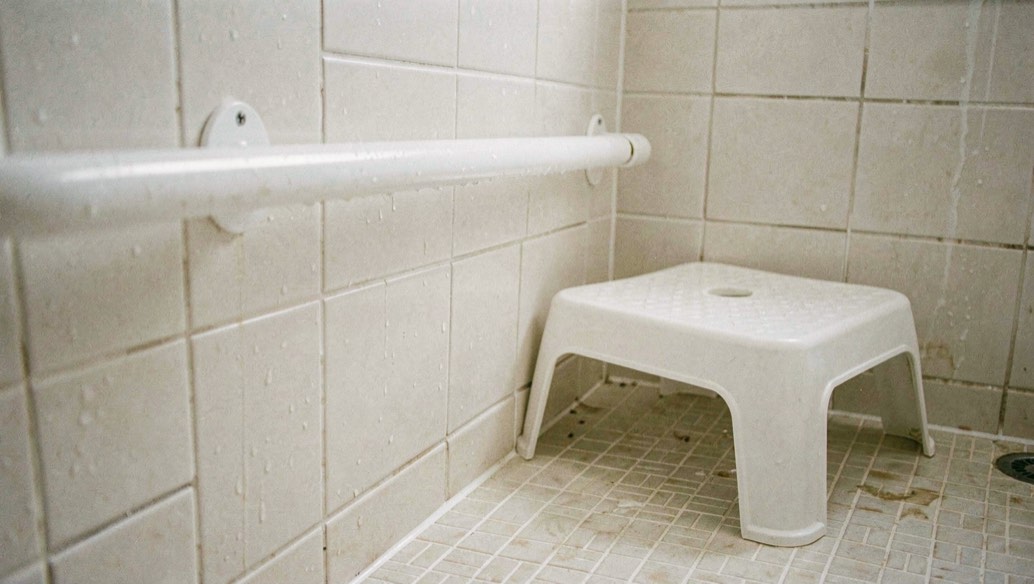
Less exotically than the phrase suggests. A grab rail beside the bath. A shower with no step to it. A second banister, a ramp at the door, a perching stool in the kitchen, a lighter tap. Then the electronic end of the same idea: a reminder that speaks when it is time for tablets, a detector that raises an alarm after a fall, a sensor that turns a light on before somebody crosses a dark hallway. None of it is medical equipment and none of it is furniture. It is the equipment that decides whether a person can manage a task in their own home, which is why it belongs to the same system as everything else on this site.
Who works out what is needed?
The council, through the assessment that runs the rest of the subject. The difference here is the level of detail: an adaptation only makes sense at the scale of a task in a room, so the assessment that leads to one has to name the task, the room and the way the task is managed today. A need described as mobility is not assessable. A need described as getting in and out of the bath on a Tuesday morning is, and it points straight at the object that answers it.
Why does it have to be in the plan?
Because the plan is where the council records what it has decided to meet and how. Section 24 of the Care Act 2014 sets out the steps the council has to take, and section 25 is titled Care and support plan, support plan. Section 18 carries the duty to meet needs where the conditions are met, and section 19 the power to meet others. An adaptation that lives in a conversation and never reaches the plan has no decision behind it, and therefore no money and no timescale. the care and support plan sets out what the document must hold, and the rail belongs in it like any other line.
Care Act 2014, sections 18, 19, 24 and 25. Version Latest available (Revised) as at 2 September 2026, legislation.gov.uk, read on 3 September 2026.
Where does the money come from?
From the plan. What it costs to meet the needs the council has agreed to meet is carried as a figure against that plan, and equipment and small works are met from it like any other form of support. the personal budget explains how the figure is built and what questions to ask about it. No amount for any piece of equipment is printed on this page, because amounts move and this handbook does not reprint them: the figure that counts is the one in the plan.
Why is a small thing sometimes funded first?
Because the Act has a section for it. Section 2 is titled Preventing needs for care and support, and it is the part of the law that lets a council act before a need grows into something bigger. A rail fitted in March can be the reason a fall does not happen in June, and a fall avoided is an admission avoided, a hospital stay avoided and a support package that never has to be rewritten. Prevention is also where the smaller sums live, which is one of the few places in this subject where the cheaper option and the better one are usually the same option.
Care Act 2014, section 2, Preventing needs for care and support. Version Latest available (Revised) as at 2 September 2026, legislation.gov.uk, read on 3 September 2026.
How does the sequence run?
In three steps, always the same three.
- Step 1The need is assessed, at the scale of a task in a room, and described in those words rather than in a category.
- Step 2It is written into the plan, with the object or the hours that answer it, so that it carries a decision and a budget.
- Step 3It is arranged and fitted, and then used: a rail that is fitted and avoided has not met a need, and it belongs back in the review.
What does telecare do well, and what does it not do?
It does time well. A spoken reminder at the right hour, a light that comes on before the stairs, an alarm that reaches somebody when a person cannot reach it themselves: these are cheap, reliable and undemanding, and they suit needs that repeat on a schedule. What they do not do is notice the thing that sits outside their pattern, keep somebody company, or make a judgement. A pendant is not a person, and a package that has drifted towards sensors because sensors are simpler to buy has usually drifted away from what the assessment actually said. Both halves of that sentence are worth checking at a review.
What if the home is not yours to alter?
Then the landlord is in the chain, and the chain still works. In a tenanted home, alterations are agreed with the landlord, which is one of the practical reasons the tenancy matters: supported living explained sets out whose name the agreement should be in. Where the building is a care home, the organisation that runs it alters its own building, and residential care homes describes what that arrangement covers. What cannot be altered is worth knowing before a move rather than after, which is one of the questions behind kinds of home and area.
Where does health come into it?
At the edges, and the edges matter. Tablet organisers, spoken reminders and the routines built around them are part of how a person manages their own health, and health has a page of its own: staying healthy covers the yearly check the NHS offers and the register that sits behind it. An adaptation that makes a morning routine work is doing health work without being called that, and it is a fair example of why the housing part of a plan and the health part of a life are not separate conversations.
Sources read for this page
- Care Act 2014, revised text on legislation.gov.uk, version Latest available (Revised) as at 2 September 2026
- Care and support statutory guidance, Department of Health and Social Care, updated 22 July 2025
Each source above was opened on 3 September 2026. Where a page here prints a section number or a figure, the source line beside it names the version that number was read from.